A new form of staking is on the rise called proof-of-stake (POS). This technology has the ability to change the entire cryptocurrency landscape moving forward. Especially in regards to how people earn money through cryptocurrencies, things are about to change big time.
The Proof of Stake Algorithm Explained
Before we get into how proof of stake works, we first need to understand how the proof of work algorithm functions. A common analogy for this is a new form of mining. Instead of using pickaxes and shovels, people would use their computer power to solve complex equations or problems.
In return for donating this valuable computing time to solving these equations, they are given rewards in the form of coins and tokens. These can be used for trading on BitQT, where you can buy and sell cryptocurrencies.
Proof of Work in Action
To see how proof of work works, take a look at the following example. Alice is mining Bitcoin on her computer when suddenly she sees Bob’s block come into existence. In order to solve this recently found block, Alice will have to redo all the hashing that was done for this block but will not get any additional Bitcoins for her efforts. If Alice solves this problem before anyone else, she will receive the 25 BTC reward and Bob’s transaction fees.
This process repeats itself over and over again in the world of cryptocurrencies. More computing power means a better chance of finding that next block and receiving its associated rewards. After all, the miner that finds the next block gets to keep all of its respective rewards
What Does Proof of Stake Mean?
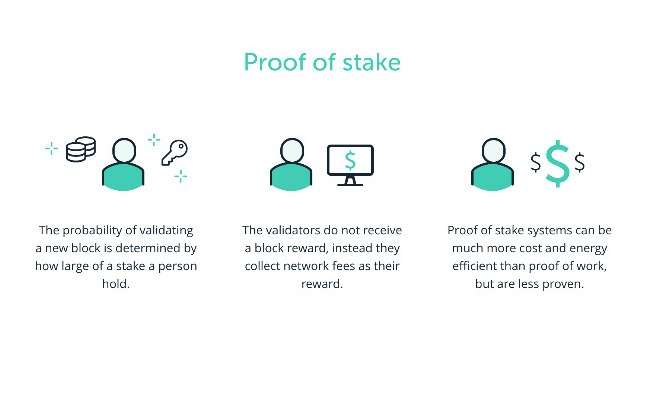
Proof of stake is a different way to validate transactions. Instead of having miners use their computing power to solve complex equations or problems, they are chosen based on how much cryptocurrency they hold. The more cryptocurrency you have in your possession, the more of a chance you have of being selected to validate transactions.
If you solve one of these problems or “stake” on the next block before anyone else, you get to keep all the associated rewards such as transaction fees and newly minted cryptocurrencies
This process can be better understood by looking at an example. Bob decides he wants to stake some cryptocurrencies to try and make extra money. He looks over the options available but notices there is a fixed fee associated with this process.
To staking Dash, Bob must pay 0.1 Dash as a security deposit for participating in the network. If he later decides to stop staking, his deposit will be returned minus any transaction fees.
After Bob pays his 0.1 Dash deposit, he is randomly chosen to validate a block on the blockchain. He then sets out to solve this problem and does so before anyone else in the network. In return for being the first one to solve this problem, he receives transaction fees and a newly minted coin.
Bob then goes to sleep confidently he will receive his 0.1 Dash deposit back in the morning but wakes up disappointed. When staking cryptocurrencies such as Dash, Bob was required to keep his computer on and running at all times. If he had turned off his computer after staking for over 24 hours, he would have lost his deposit and associated transaction fees.
Proof of Stake Transforming the Crypto Space
The proof of stake algorithm is about to change how we approach cryptocurrencies and mining forever. This new form of mining will mean that no more expensive graphics cards or other computer hardware are required.
This is a major development as people would no longer have to spend big money on mining equipment. In fact, anyone can stake their cryptocurrencies by keeping their personal computers turned on at all times.